
Cat-Back vs Turbo-Back: Where Does the Upgrade Begin?
The names describe how much of the exhaust system is replaced, but actual sections and regulations depend on the car.
Pocket Performance is an independent affiliate discovery service. We may earn a commission if you buy through a retailer link at no additional cost to you. Product fitment and seller terms must be checked at the retailer.
The names describe how much of the exhaust system is replaced, but actual sections and regulations depend on the car.
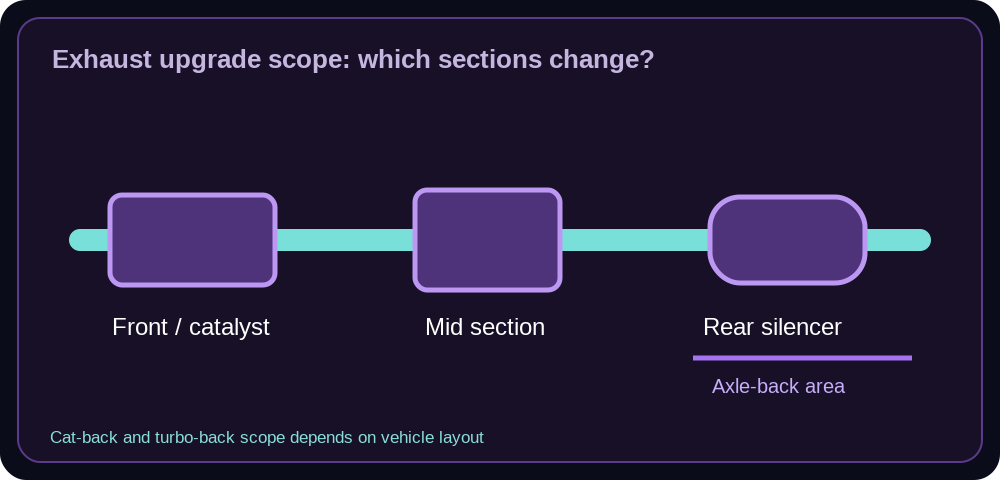
Decision points at a glance
Compare the practical differences below, then use the detailed sections and supplier information to confirm the correct component for your car.
| Comparison | Cat-back | Turbo-back |
|---|---|---|
| Starting point | After catalyst (typical) | Turbo outlet (varies by car) |
| Installation | Downstream hangers and routing | May involve sensors, shielding and catalyst |
| Road use | Still check noise and fitment | Emissions rules can be particularly relevant |
Cat-back: downstream of the emissions catalyst
A cat-back typically comprises sections after the catalytic converter, often including a centre resonator and rear silencer. It can change sound, weight and corrosion resistance without necessarily changing the catalytic converter itself.
Turbo-back: wider scope on turbocharged vehicles
Turbo-back can describe the system downstream of a turbo outlet. On some layouts this includes downpipe and catalyst-related sections; using the label does not mean emissions equipment can legally be removed. Verify the exact supplier diagram.
Compare the practical tradeoffs
A full-system replacement has more joints, hangers and clearance constraints to inspect. Valves, oxygen sensors, particulate filters and vehicle-specific bumpers can complicate installation. Driving refinement, noise compliance, warranty and original-system reuse are part of the decision.
Choose your next step
Make the decision in the right order: identify your exact car and use case, compare the component types, check the seller application, then review current supplier terms. Pocket Performance does not certify any individual listing as a guaranteed vehicle fit.
Interpreting exhaust product descriptions correctly
A manufacturer might call a system “cat-back” even when the exact downstream sections differ on models with secondary catalysts, particulate filters or multiple silencers. Use its fitting diagram to identify every joint and component retained. Likewise, “turbo-back” is not a universal bill of materials; some systems omit emissions-related sections while others replace them, and some configurations may not be approved for road use.
When comparing options, check whether the original downpipe flange, exhaust valves, electronic controls, hangers, heat shields and sensors remain compatible. A change in exhaust diameter can require specific adapters; a different rear bumper or diffuser may change tailpipe position. Do not assume two model years share the same routing simply because their engine family is the same.
Choose the scope around the purpose. If you primarily want a different tone, an appropriately resonated downstream system may be more relevant than replacing upstream emissions-related parts. If you have a documented restriction for a competition vehicle, consult the supplier and a qualified specialist about the complete installation and lawful use.
Technical references
Use the original manufacturer or official guidance below to verify specifications and legal requirements for your exact vehicle and intended use.