
Engine Bay Upgrades That Support the Whole Setup
An upgrade plan should solve an evidenced limitation in intake flow, charge temperature, fluid temperature, mounting or durability.
Pocket Performance is an independent affiliate discovery service. We may earn a commission if you buy through a retailer link at no additional cost to you. Product fitment and seller terms must be checked at the retailer.
An upgrade plan should solve an evidenced limitation in intake flow, charge temperature, fluid temperature, mounting or durability.
Decision points at a glance
Compare the practical differences below, then use the detailed sections and supplier information to confirm the correct component for your car.
| Upgrade area | What to measure | Typical oversight |
|---|---|---|
| Induction | Air source temperature and restriction | Engine-bay heat soak |
| Intercooling | Charge temperature, pressure drop and airflow | Blocking radiator airflow |
| Mounts/hoses | Condition, load and installation | Added NVH or unsuitable materials |
Intake and filtration choices
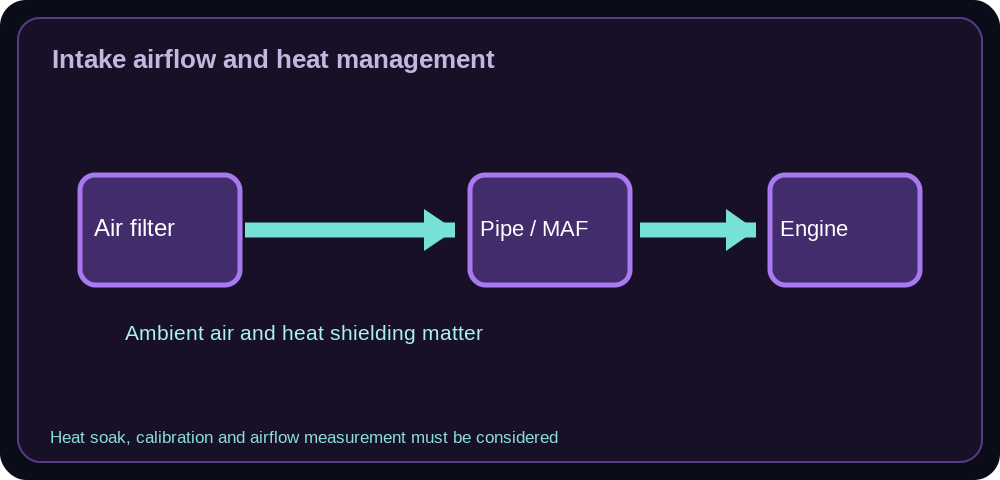
A factory airbox often manages temperature and filtration effectively. An intake may change sound, restriction or packaging; the outcome depends on the whole path and the vehicle’s air-measurement strategy.
Heat management and cooling
Intercoolers trade heat-transfer area against pressure drop and available airflow. Hoses and clamps need appropriate pressure, temperature, movement and chemical resistance. A larger component that obstructs radiator airflow may compromise another part of the system.
Supporting hardware and honest expectations
Braces, mounts, fasteners and shields can be important to a complete installation but cannot guarantee a power increase. Baseline the vehicle condition, identify the actual limitation and document any change under comparable conditions.
Choose your next step
Make the decision in the right order: identify your exact car and use case, compare the component types, check the seller application, then review current supplier terms. Pocket Performance does not certify any individual listing as a guaranteed vehicle fit.
Build the supporting system in the right order
Start with a baseline: existing intake-air temperature behaviour, fluid condition, hose integrity, warning lights and any measured boost leakage. A new intercooler may be beneficial for repeated high-load use but may also require different pipe routing or cooling-stack airflow management. An oversized intake tube can affect sensors and calibration on vehicles that meter air through a specific sensor location.
Inspect material compatibility. Silicone hoses, rubber couplers, metal pipework, clamps, fasteners and heat shields face different temperatures, pressures, vibration and chemical exposure. A shiny part is not necessarily better suited to the job. Clearance around the exhaust manifold or turbocharger is especially important under engine movement.
When multiple parts are changed at once, it becomes harder to identify a noise, leak or performance change. Keep old components and installation records where practical, photograph original hose and wiring routes, and compare results under similar conditions. More advertised airflow is not the same as a guaranteed engine power gain.