
Open Cone or Enclosed Intake: Which Is Sensible?
The most audible induction upgrade is not necessarily the most effective air-management solution.
Pocket Performance is an independent affiliate discovery service. We may earn a commission if you buy through a retailer link at no additional cost to you. Product fitment and seller terms must be checked at the retailer.
The most audible induction upgrade is not necessarily the most effective air-management solution.
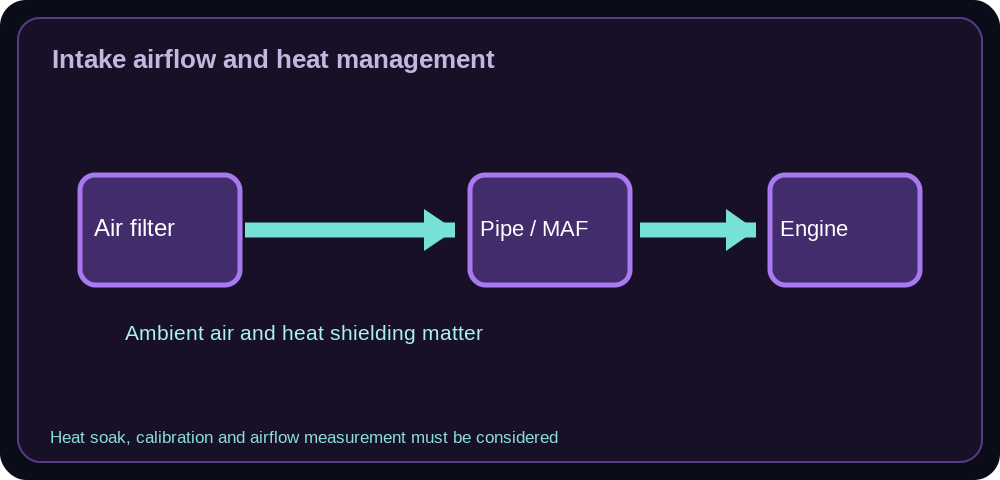
Decision points at a glance
Compare the practical differences below, then use the detailed sections and supplier information to confirm the correct component for your car.
| Comparison | Open cone | Enclosed/airbox |
|---|---|---|
| Induction sound | Often more audible | Often more contained |
| Air temperature | Shielding and location important | Still depends on duct seals and source |
| Integration | Filter, sensor and splash protection | Restriction, sensor and maintenance |
Open cone systems
An open filter can increase induction sound and may simplify packaging. If mounted in a hot engine bay without shielding or a suitable air feed, it may ingest warmer air and reduce intake-air density.
Enclosed and airbox systems
An enclosed arrangement aims to isolate the filter from engine-bay heat and route suitable ambient air. Its effectiveness still depends on ducting restriction, filter area, sealing and maintenance.
Measurement, sensors and daily use
Mass-airflow sensor placement, contamination, water splash paths and ECU calibration can determine whether an intake operates correctly. Compare measured temperatures and the whole system’s pressure behaviour rather than relying only on a dyno headline or social video.
Choose your next step
Make the decision in the right order: identify your exact car and use case, compare the component types, check the seller application, then review current supplier terms. Pocket Performance does not certify any individual listing as a guaranteed vehicle fit.
Where “cold air” claims break down
Air temperature is not determined by filter shape alone. The temperature at the inlet, distance from the exhaust manifold or radiator, duct sealing and vehicle speed all affect the result. An open intake in a cool, well-isolated area can behave differently from a similar filter directly above a hot turbocharger. Likewise, an enclosed box with a narrow feed may still impose restriction.
Modern engines can rely on sensor calibration, intake resonance and carefully shaped airflow before the throttle or compressor. Changing the measurement-tube diameter, removing air-straightening elements or exposing the filter to excess oil can create problems that sound or visual appearance will not reveal. Inspect the supplier’s installation instructions and warranty conditions.
A practical comparison records charge or intake temperature where available, ambient temperature, filter condition and driving use. A claimed power gain that disappears after repeated hot runs is not the same outcome as stable performance. Filtration quality and water exposure should remain priorities on a year-round road car.